
Famous for its bold, malty black teas with a deep colour and full body, Assam tea comes from the northeastern Indian state of Assam, along the Brahmaputra River. As one of the world’s largest tea-producing regions, Assam accounts for nearly 55% of India’s total tea production, with over 800 major estates and thousands of smaller gardens supplying a substantial portion of the global black tea market. While large estates dominate industrial-scale production, organic cultivation is mostly confined to small family farms and smallholdings, which often lack the resources to export to international markets.
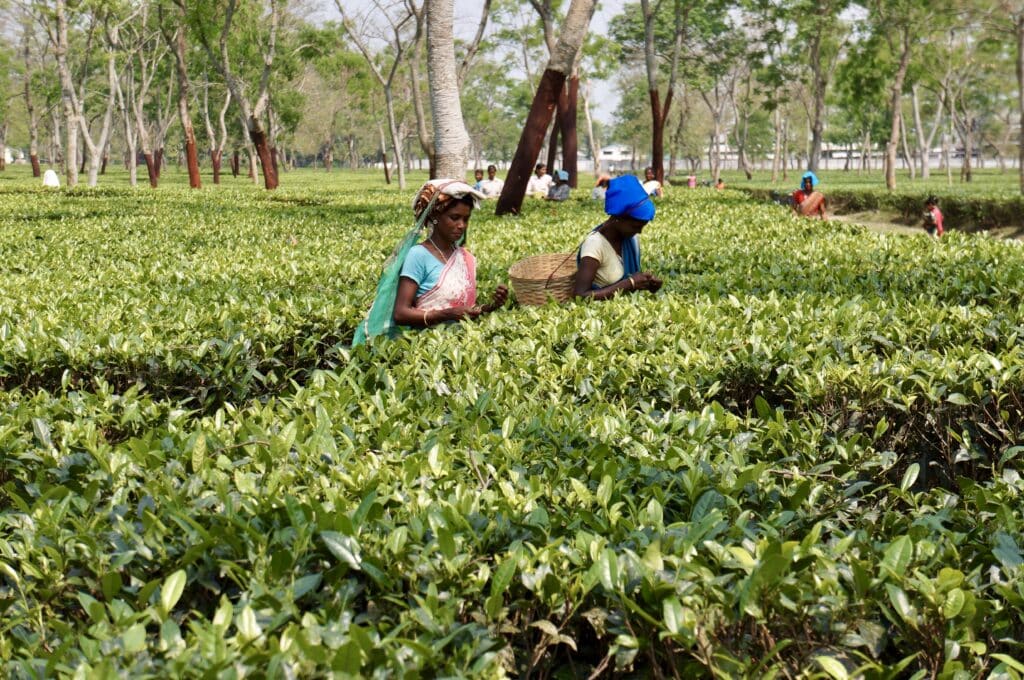
Unlike smaller tea regions such as Darjeeling or the Nilgiri Hills, tea production in Assam is a large-scale industrial operation. Within this system, efficiency, yield, and consistency are key priorities. While some estates produce orthodox tea and emphasise quality and sustainability, the majority of large-scale producers are vast, company-owned plantations producing CTC (crush, tear & curl) tea in high volumes and rely on modern farming techniques – including the use of pesticides – to maximise output.

This approach is not driven by negligence or greed but by economic realities. Rising labour costs, energy expenses, and logistics challenges have increased production costs. Combined with climate change impacts such as irregular rainfall, extreme heat, and seasonal flooding, these factors have made it increasingly difficult to maintain supply and quality.
Assam tea estates have traditionally used pesticides such as Thiacloprid to manage pests, including the destructive tea mosquito bug. These chemicals are regulated by India’s Central Insecticides Board and Registration Committee (CIBRC) in coordination with the Tea Board of India to ensure crop protection while minimising environmental risks.

The most immediate factor behind the shortage of Assam tea in Europe is the lowering of the legally allowed maximum residue limit for the pesticide Thiacloprid in agricultural imports.
In 2020, the EU banned Thiacloprid for use within member states due to health and environmental concerns but allowed an import tolerance of up to 10 mg/kg for residues. Following scientific assessments and a policy alignment with the internal ban, the EU’s Regulation 2024/2711, which came into effect in 2025 EU lowered the maximum residue limit to the technical detection limit of 0.01–0.05 mg/kg.
While this legislation was not specific to tea, its impact has been felt strongly by Assam tea exporters. Many conventional estates that previously relied on Thiacloprid now face stricter compliance standards, reducing the volume of tea eligible for export to Europe.

Yes and no! Organic Assam teas are produced without synthetic pesticides and are therefore unaffected by the new EU regulations. However, organic tea production in Assam has always been in short supply due to lower yields. As global demand grows and conventional supply is constrained, organic Assam tea is increasingly sought after, even though it comes at a higher price and is harder to come by.
Yes, blends that rely on Assam tea, especially CTC teas, such as English Breakfast, Irish Breakfast and East Frisian tea are also impacted by the reduced supply and stricter EU pesticide regulations. These classic blends often depend on the bold, malty character of Assam to provide body, colour, and depth. With conventional Assam tea in shorter supply, some tea blenders have begun substituting it with alternatives such as Kenyan or Ceylon black teas, which can mimic the strength and colour but may lack the distinctive malty richness of Assam. This shift ensures continued availability of popular blends in European markets but may lead to subtle differences in taste and aroma for discerning tea drinkers.
The scarcity of Assam black tea in Europe is the result of multiple converging factors: industrial-scale production pressures, rising costs, climate change, and now stricter EU pesticide regulations. For tea purists who do want to forgo the delicious malty flavour of Assam tea, Chinese black teas, especially those from Yunnan such as China Golden Yunnan Mao Feng, offer a good alternative. These come from the same variety of the tea plant, are medium to full bodied and have a delicious malty, cocoa like, slightly sweet flavour.
For the higher quality orthodox tea blends such as English Breakfast tea or Irish Breakfast tea blenders will most likely turn to teas from Kenya, which provide the brisk, full-bodied cup desired for teas which are often enjoyed with milk.
| Cookie | Duration | Description |
|---|---|---|
| __stripe_mid | 1 year | This cookie is used by our payment provider Stripe to process payments. |
| __stripe_sid | 30 minutes | This cookie is used by our payment provider Stripe to process payments. |
| cookielawinfo-checkbox-analytics | 1 year | The cookies is used to store the user consent for the cookies in the category “Analytics”. |
| cookielawinfo-checkbox-necessary | 1 year | The cookies is used to store the user consent for the cookies in the category “Necessary“. |
| CookieLawInfoConsent | 1 year | This cookie is used to record the default button state of the corresponding category. |
| viewed_cookie_policy | 1 year | The cookie is used to store whether or not user has consented to the use of cookies. |
| woocommerce_cart_hash | session | This cookies is used to determine when cart contents/data changes. |
| woocommerce_items_in_cart | session | This cookie is used to determine when cart contents/data changes. |
| wp_woocommerce_session_* | 2 days | This cookie is used to find the cart data in the database for each customer. |
| Cookie | Duration | Description |
|---|---|---|
| _ga | 2 years | This cookie is used by Google Analytics to calculate visitor, session and campaign data for the sites analytics reports. |
| _ga_* | 2 years | This cookie is used by Google Analytics to calculate visitor, session and campaign data for the sites analytics reports. |

Call us during opening hours on + 49 (0) 711 518 74 006 or email us using the form below. We will get back to you as soon as we can.